University of Wisconsin Logo
University of Wisconsin Mark

All In Wisconsin

  • Our Impact
  • About Us
  • Faculty & Staff
  • News
Search Icon
Universities of Wisconsin Constellation
Browse all sites
  1. Universities of Wisconsin
  2. All In Wisconsin
  3. Campus Stories
  4. Microbes mutated in space hint at biomedical benefits to humans on Earth

Microbes mutated in space hint at biomedical benefits to humans on Earth

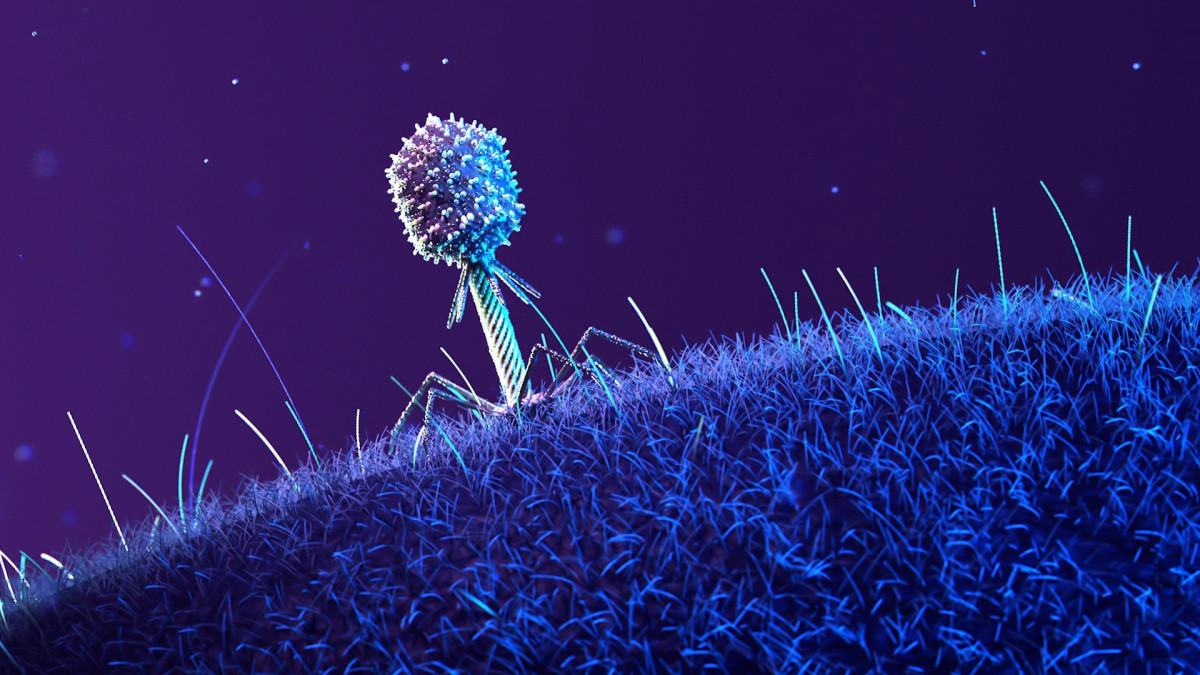
In this illustration, a phage—a type of virus that infects bacteria—rests on the surface of a host cell. Researchers at UW–Madison designed an experiment for the International Space Station to study how phage-bacteria interactions affect the health of the gut microbiome.

Researchers are interested in studying effects on the gut microbiome and antibiotic-resistant infections

In September 2020, UW–Madison biochemists launched a small box containing viruses and bacteria into space to investigate the ways microbes such as those residing in our guts respond to space conditions. Now, the bacteria and phages (viruses that infect bacteria) have returned to Madison with hints about how space travel may impact the gut microbiome and clues about how to treat antibiotic-resistant bacterial infections on Earth.

“Our experiment was about more than learning what happens when bacteria and phages travel in outer space. We are asking questions about how mutations acquired in space might be relevant on Earth,” says biochemistry professor Vatsan Raman, who led the project. The researchers’ findings are reported in the journal PLOS Biology.

Bacteria-phage relationships are essential to maintaining a healthy balance in the human gut microbiome: Gut bacteria evolve to evade infection, and in response, phages mutate to find new ways to infect bacteria. Raman’s lab is harnessing this relationship to design phages that can compete with and combat bacterial infections.

“Space is such a unique environment,” says Philip Huss, a postdoctoral researcher in the Raman Lab and a lead author on paper. “It has the potential to reveal possibilities for how phages can evolve that are hidden on Earth.”

With scientists and astronauts spending extended periods of time in space — and the onset of recreational space travel — it’s become important to understand how environments with reduced gravity (microgravity) impact the evolutionary dance between bacteria and phages. Sustained microgravity is difficult to establish on Earth. But on the International Space Station, a space-based national laboratory, it’s possible to do research in the near-weightless conditions that are ideal for the Raman Lab’s study.

“On Earth, we know that phages move around their environment and find a bacterial host to infect. Then they enter and kill the bacteria,” explains Raman. “But in outer space, do these rules of engagement still apply? If there is no gravity, then the way that phages move around their environment will just be different. The ways they attack bacteria will be different.” The UW–Madison scientists engineered phages to exhibit thousands of different mutations and sent them to space. For 25 days, ISS scientists incubated different combinations of the phages and bacteria together and in isolation. Back in Madison, the same experiments were replicated under Earth’s gravity.


Designing an experiment for space

Designing a space-bound experiment required that the researchers stick to a prescribed set of materials that can fit in a confined space. To ensure that their study was feasible and met the safety standards of ISS research, the team partnered with Rhodium Scientific, a biotechnology company that works with researchers to facilitate scientific exploration in space.


Huss and Chutikarn Chitboonthavisuk (a former graduate student in the Raman Lab) found key differences when they compared the phages and bacteria grown in space with those grown on Earth. In space, the phages and bacteria acquired novel mutations: Proteins on the surfaces of bacteria changed and in turn, phages mutated to bind to these altered surfaces. As a result, the mutations that allowed phages to infect bacteria in space differed from those on Earth.

Three people wearing white lab coats smile as they look through plexiglass at an experiment running in a research lab.
Vatsan Raman (right), then-graduate student Chutikarn Chitboonthavisuk (left) and postdoctoral researcher Philip Huss (center) compared the phages and bacteria grown in space with those grown on Earth. PHOTO BY: Paul EscalanteThe Raman Lab then engineered phages with a variety of mutations that were successful in space to test their effectiveness against bacterial pathogens on Earth, putting the novel phages to work against bacteria responsible for urinary tract infections. Currently, more than 90% of the bacteria that cause UTIs are resistant to at least one antibiotic.“We found that the novel combinations of phage mutations were really effective at killing UTI pathogens on Earth,” says Raman. “And that’s pretty surprising. Why would an experiment in space inform how to design phage therapies on Earth? We don’t exactly know, but one of our hypotheses is that the environmental factors stressing UTI bacteria somehow mimic the stress bacteria experience in microgravity, making their surface proteins similar.”With the experience gained through their first experiment’s voyage, the researchers are now working on answering bigger questions — with experiments that must still fit in the same, small box — for a future space launch.“First, we asked basic microbiology questions, just in space,” says Huss. “Now, we’re ready to study systems of multiple phages and bacteria that more closely represent the complexity of the human microbiome. What novel interactions occur in space, and what can we learn from them here on Earth?”


Written by Renata Solan

Link to original story: https://news.wisc.edu/microbes-mutated-in-space-hint-at-biomedical-benefits-to-humans-on-earth/

Recents
  • Microbes mutated in space hint at biomedical benefits to humans on Earth

    Tuesday, January 27, 2026

  • Community Capital: How Credit Unions and Universities Partner to Strengthen Wisconsin

    Monday, January 26, 2026

  • UW-Stout students collaborate across degrees in community project for The Neighbors

    Wednesday, January 21, 2026

Recents
Yearly
  • 2026
  • 2025
  • 2024
  • 2023
  • 2022
  • 2021
  • 2020
  • 2019
  • 2018
  • 2017
  • 2016
  • 2015
  • 2014
  • 2013
  • 2012
Monthly
  • January 2026
  • December 2025
  • November 2025
  • October 2025
  • September 2025
  • August 2025
  • July 2025
  • June 2025
  • May 2025
  • April 2025
  • March 2025
  • February 2025
  • January 2025
  • December 2024
  • November 2024
  • October 2024
  • September 2024
  • August 2024
  • July 2024
  • June 2024
  • May 2024
  • April 2024
  • March 2024
  • February 2024
  • January 2024
  • December 2023
  • November 2023
  • October 2023
  • September 2023
  • August 2023
  • July 2023
  • June 2023
  • May 2023
  • April 2023
  • March 2023
  • February 2023
  • January 2023
  • December 2022
  • November 2022
  • October 2022
  • September 2022
  • August 2022
  • July 2022
  • June 2022
  • May 2022
  • April 2022
  • March 2022
  • February 2022
  • January 2022
  • December 2021
  • November 2021
  • October 2021
  • September 2021
  • August 2021
  • July 2021
  • June 2021
  • May 2021
  • April 2021
  • March 2021
  • February 2021
  • January 2021
  • December 2020
  • November 2020
  • October 2020
  • September 2020
  • August 2020
  • July 2020
  • June 2020
  • May 2020
  • April 2020
  • March 2020
  • February 2020
  • January 2020
  • December 2019
  • November 2019
  • October 2019
  • September 2019
  • August 2019
  • July 2019
  • June 2019
  • May 2019
  • April 2019
  • March 2019
  • February 2019
  • January 2019
  • December 2018
  • November 2018
  • October 2018
  • September 2018
  • August 2018
  • July 2018
  • June 2018
  • May 2018
  • April 2018
  • March 2018
  • February 2018
  • January 2018
  • December 2017
  • November 2017
  • October 2017
  • September 2017
  • August 2017
  • July 2017
  • June 2017
  • May 2017
  • April 2017
  • March 2017
  • February 2017
  • January 2017
  • December 2016
  • November 2016
  • October 2016
  • September 2016
  • August 2016
  • July 2016
  • June 2016
  • May 2016
  • April 2016
  • March 2016
  • February 2016
  • January 2016
  • December 2015
  • November 2015
  • October 2015
  • September 2015
  • August 2015
  • July 2015
  • June 2015
  • May 2015
  • April 2015
  • March 2015
  • February 2015
  • January 2015
  • December 2014
  • November 2014
  • October 2014
  • September 2014
  • July 2014
  • June 2014
  • May 2014
  • April 2014
  • March 2014
  • January 2014
  • December 2013
  • November 2013
  • October 2013
  • September 2013
  • August 2013
  • July 2013
  • June 2013
  • May 2013
  • April 2013
  • March 2013
  • February 2013
  • January 2013
  • December 2012
  • November 2012
  • October 2012
Universities
  • Freshwater Collaborative of Wisconsin
  • Universities of Wisconsin
  • UW Colleges
  • UW Extended Campus
  • UW-Eau Claire
  • UW-Extension
  • UW-Green Bay
  • UW-La Crosse
  • UW-Madison
  • UW-Milwaukee
  • UW-Oshkosh
  • UW-Parkside
  • UW-Platteville
  • UW-Platteville; UW-La Crosse
  • UW-River Falls
  • UW-Stevens Point
  • UW-Stout
  • UW-Superior
  • UW-Whitewater
Categories
  • Community
  • Economic Development
  • Research & Innovation
Universities of Wisconsin
Facebook Icon X Icon LinkedIn Icon Instagram Icon YouTube Icon
Office of Public Affairs, Communications, and Branding
Madison, WI 53706

universityrelations@wisconsin.edu

Employee Intranet

© 2026 Board of Regents - University of Wisconsin System. All Rights Reserved

All Sites | Accessibility | Privacy | Contact Webmaster